
My uncle crashed his 1998 Bajaj Pulsar at 60 km/h. Broken collarbone, fractured wrist, two months of recovery.
Last month, my friend Karthik crashed his 2024 Royal Enfield at 80 km/h. He walked away with minor bruises. His bike? The safety systems kicked in before impact, reducing speed automatically.
Same type of accident. Twenty-six years of engineering progress. Completely different outcomes.
Modern motorcycles aren’t just faster than their predecessors. They’re dramatically safer. And the technology making this possible is spreading from premium superbikes to everyday commuter bikes available in India.
Let me show you exactly how bikes have evolved to deliver speed and protection in ways that seemed impossible just a decade ago.
Electronic Riding Aids Have Revolutionized Control
Ten years ago, traction control and ABS were exotic features on bikes costing ₹15+ lakhs. Today, they’re appearing on motorcycles under ₹2 lakhs.
This isn’t just feature creep. It’s technology that actively prevents crashes.
Anti-Lock Braking System (ABS) Saves Lives
ABS prevents wheel lockup during emergency braking. Sounds simple. The impact is massive.
When you panic brake without ABS, the front wheel locks. The bike loses stability and slides out from under you. This happens in a fraction of a second—faster than you can react.
ABS pulses the brakes rapidly (up to 15 times per second), maintaining traction while maximizing braking force.
Real-world difference:
- Without ABS: 40-meter stopping distance, high crash risk
- With ABS: 35-meter stopping distance, bike stays upright
- That 5-meter difference often means the difference between crash and close call
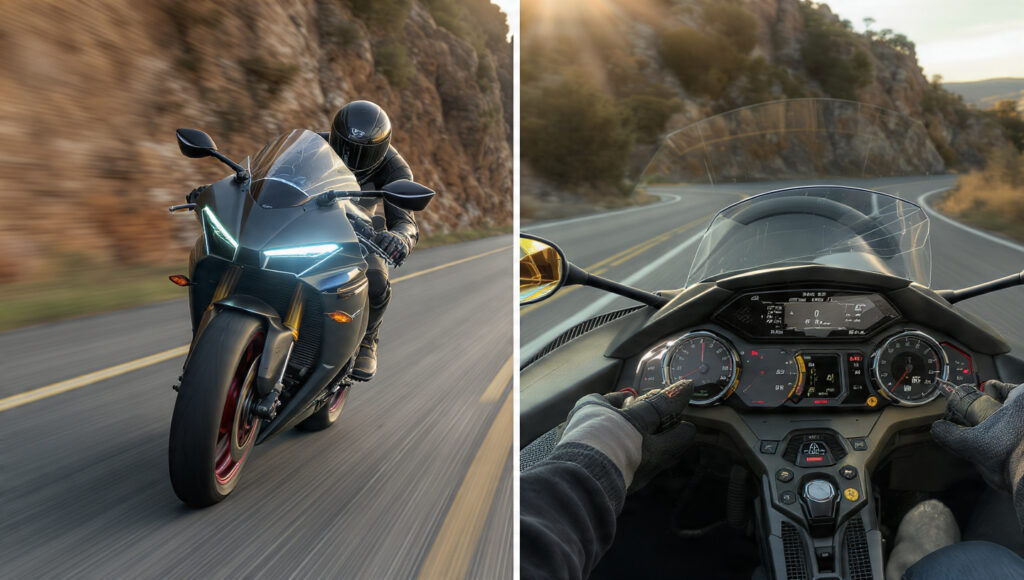
Rohan rides a TVS Apache RTR 200 4V with ABS. Last week, a car cut across his path on a wet road. He grabbed both brakes hard. The ABS kicked in immediately. He stopped in time. Without ABS, he says he’d have definitely crashed.
Since ABS became mandatory on bikes above 125cc in India (2019), motorcycle fatalities in that segment have dropped noticeably. The technology works.
Traction Control Prevents Rear Wheel Spin
Traction control monitors rear wheel speed versus front wheel speed. If the rear spins faster (losing traction), the system cuts power momentarily.
This prevents:
- Wheelspin when accelerating hard from signals
- Rear sliding out in corners
- Loss of control on wet or gravel roads
- Unintentional wheelies that lead to crashes
Priya upgraded from a basic Duke 200 to the newer model with traction control. She rides daily in Bangalore’s unpredictable traffic. During monsoon, she’s noticed the system intervening several times when accelerating from wet intersections. “I didn’t even realize I was losing traction until I felt the bike stabilizing itself,” she told me.
Traction control availability in India (2025):
- Budget segment (under ₹2L): Appearing on select models
- Mid-range (₹2-5L): Becoming standard
- Premium (above ₹5L): Standard with multiple modes
Cornering ABS Takes It Further
Standard ABS works great in straight-line braking. But what about braking while leaning in a corner?
Cornering ABS uses lean angle sensors. It knows exactly how far the bike is tilted. It adjusts braking force accordingly to prevent wheel lockup while maintaining lean angle.
This technology came from MotoGP racing. Now it’s on bikes you can buy in India.
Sanjay rides a Kawasaki Ninja 650 with cornering ABS. He was descending a mountain road when a truck appeared mid-corner. He braked hard while leaned over. The system prevented the front wheel from washing out. “On my old bike, I would’ve crashed or run off the road,” he said.
Engine Technology Delivers More Power Safely
Modern bikes produce significantly more power than older models—while being more reliable and easier to control.
Variable Valve Timing Optimizes Performance
Variable valve timing (VVT) adjusts valve opening duration based on engine speed. This delivers:
- Strong low-end torque for city riding
- High-end power for highway speeds
- Better fuel efficiency
- Smoother power delivery
The TVS Apache RTR 160 4V uses VVT. This 160cc bike produces power similar to older 180cc bikes, but with better control and fuel economy.
Vikram commutes 40 km daily on his Apache. He gets strong acceleration from signals (helpful in Mumbai traffic) and comfortable highway cruising at 90-100 km/h. Previous 160cc bikes struggled at those speeds.
Ride-by-Wire Gives Precise Throttle Control
Ride-by-wire eliminates the mechanical throttle cable. An electronic sensor reads your throttle input. A computer processes it. The system then tells the engine how much power to deliver.
Why does this matter?
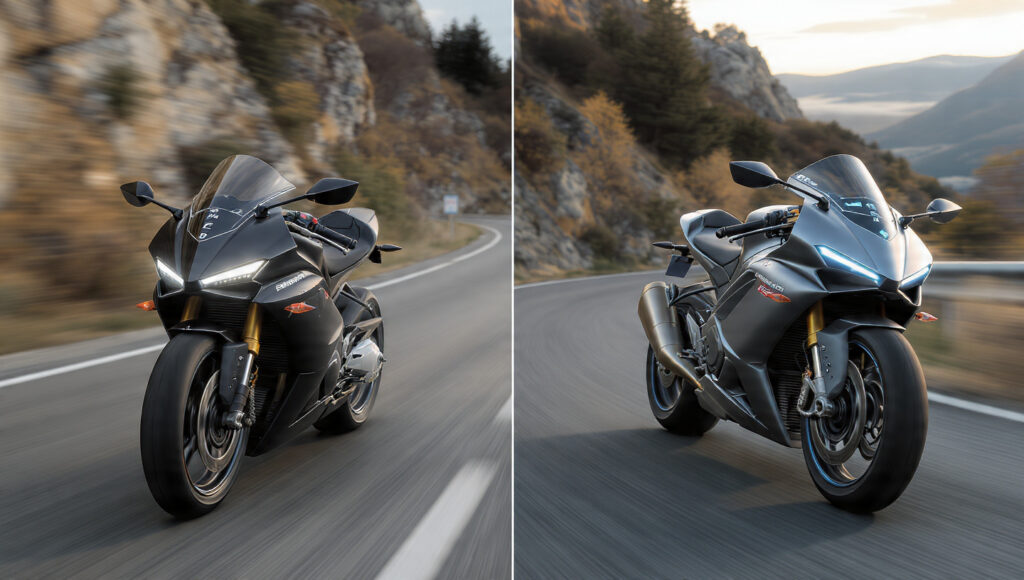
Benefits:
- Multiple riding modes (Sport, Rain, Eco) that change throttle response
- Integration with traction control and ABS
- Smoother power delivery
- Ability to limit power output for beginners
Neha bought a KTM 390 Duke as her first bike. It has 43 horsepower—scary for a new rider. But the Rain mode dulls throttle response and limits power output. She practiced for three months in Rain mode before switching to Road mode. “The same bike became beginner-friendly,” she said.
Without ride-by-wire, you can’t have this flexibility.
Quick Shifters Make Fast Riding Safer
A quick shifter allows clutchless upshifts (and downshifts on bi-directional systems) by momentarily cutting ignition when it detects gear lever movement.
This means:
- No need to close throttle or pull clutch while shifting
- Faster, smoother gear changes
- Better stability during acceleration
- Reduced rider fatigue
Arjun tracks his Yamaha R15 V4. The quick shifter lets him shift without upsetting the bike’s balance mid-corner. “I can focus on my line instead of rev-matching,” he explained.
Quick shifters used to be exotic. Now they’re appearing on bikes under ₹2 lakhs in India.
Advanced Suspension Systems Improve Stability
Better suspension doesn’t just mean comfort. It means the tires maintain contact with the road surface. And tire contact means control.
USD Forks Provide Better Front-End Stability
Upside-down (USD) forks mount the larger diameter tube at the top. This increases rigidity while reducing unsprung weight.
Practical benefits:
- Better front-end feedback during braking
- Reduced dive under hard braking
- Improved handling precision
- Better performance on poor road surfaces
Deepak upgraded from a standard Royal Enfield Classic to the Hunter 350 with USD forks. The difference on broken Pune roads surprised him. “The front end feels planted. I’m not fighting the handlebars anymore,” he said.
USD forks were once limited to superbikes. Now models like the Hero XPulse 200 4V (₹1.4 lakhs) come with them.
Monoshock Rear Suspension Enhances Traction
Older bikes used twin rear shocks. Modern bikes predominantly use monoshock systems. The single shock mounts centrally, often linking to the swingarm through a progressive linkage.
Advantages:
- More consistent suspension action
- Better traction during acceleration
- Adjustability (preload, rebound, compression)
- Reduced weight
Kavita rides aggressively on her Bajaj Dominar 400. The monoshock keeps the rear wheel planted during hard acceleration out of corners. Her previous bike (with twin shocks) would hop and slide under the same conditions.
Adjustable Suspension Lets You Tune for Conditions
Many modern bikes let you adjust suspension settings. This seems like a luxury feature, but it’s actually safety-related.
Different riding conditions need different setups:
- Solo riding vs. riding with pillion
- Highway cruising vs. twisty roads
- Track days vs. commuting
- Smooth tarmac vs. broken roads
Rahul has a Suzuki Gixxer SF 250. He adjusts preload when riding two-up. This prevents the bike from bottoming out and maintains proper geometry. “Without adjustment, the bike handles terribly with a passenger,” he noted.
Improved Frame Design Enhances Crash Protection
Modern frames are engineered using computer simulations that test thousands of crash scenarios before a single prototype is built.
Perimeter Frames Distribute Impact Forces
Perimeter frames wrap around the engine, creating a rigid structure that distributes crash forces across the entire frame rather than concentrating stress at a single point.
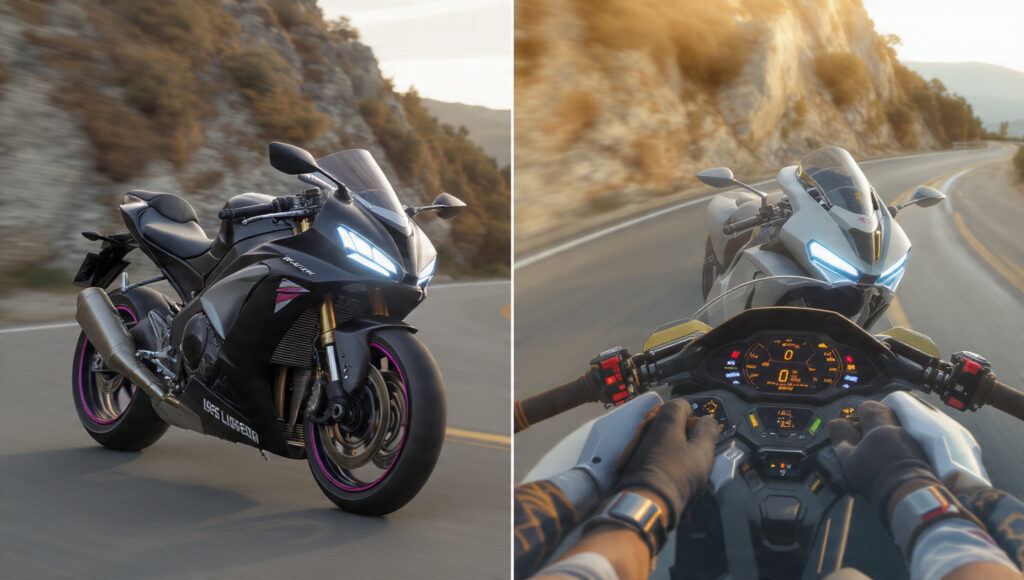
Crash protection benefits:
- Frame absorbs and distributes impact energy
- Engine acts as a stressed member, adding rigidity
- Rider’s legs are better protected
- Bike maintains structural integrity in minor crashes
Suresh crashed his KTM RC 390 after hitting gravel. The bike slid 30 meters. The perimeter frame stayed intact. The engine casings were scratched but not cracked. His old bike (with a simple diamond frame) would’ve suffered engine damage.
Crumple Zones Are Now Part of Bike Design
Cars have had crumple zones for decades. Modern bikes are incorporating similar principles.
The front fairing, frame mounting points, and certain frame sections are designed to deform in specific ways during impact. This absorbs energy before it reaches the rider.
This technology is subtle. You don’t see it until a crash happens. But it’s there, working silently.
Subframes Protect Rear Components
Bolt-on subframes support the seat and tail section. In a crash, they’re designed to break away cleanly, absorbing energy and preventing damage to the main frame.
This means:
- Less expensive repairs (replace subframe, not main frame)
- Better energy absorption in rear-end impacts
- Easier customization for different markets
Meena’s Yamaha MT-15 was rear-ended at a signal. The subframe cracked but absorbed the impact. The main frame was undamaged. Repair cost: ₹8,500. On her previous bike, the same crash damaged the main frame (₹45,000 repair).
Tire Technology Has Made Dramatic Leaps
Tires are your only contact with the road. Modern tire technology is genuinely impressive.
Dual-Compound Tires Optimize Grip
Dual-compound tires use harder rubber in the center (for longevity) and softer rubber on the edges (for cornering grip).
You get:
- Longer tire life
- Better straight-line mileage
- Excellent cornering traction
- Predictable wear patterns
Anil rides a Honda CB300F with dual-compound tires. His previous bike needed new tires every 8,000 km. These tires are still good at 12,000 km, and the cornering grip is better.
Radial Tires Improve Performance
Radial construction (where cords run perpendicular to the direction of travel) creates a more flexible sidewall and stiffer contact patch.
Riding benefits:
- Better traction
- Improved feedback
- Higher cornering speeds
- Better heat dissipation
Premium bikes used to have radials. Now bikes like the TVS Apache RR 310 (₹2.7 lakhs) come with them.
Pradeep switched his Dominar to radial tires. The improvement in corner feel was immediate. “I can tell exactly when the tire is reaching its limit. With bias-ply tires, I had to guess,” he said.
Tubeless Tires Enhance Safety
Tubeless tires are now standard on most modern bikes. In case of a puncture:
- Slow air loss (not instant deflation)
- Ability to ride to safety even with a nail in the tire
- Easier repairs
- Better heat dissipation
Rekha got a puncture on the highway doing 100 km/h. With her tubeless tire, pressure dropped gradually. She safely reached the shoulder and called for help. With a tube tire at that speed, the instant deflation could’ve caused a crash.
Lighting Technology Improves Visibility
Being seen is as important as seeing. Modern lighting makes both dramatically better.
LED Headlights See Further and Last Longer
LED headlights produce:
- 2-3x more light output than halogen
- Better color temperature (whiter light)
- Instant on/off (no warm-up)
- 50,000+ hour lifespan
- Lower power consumption
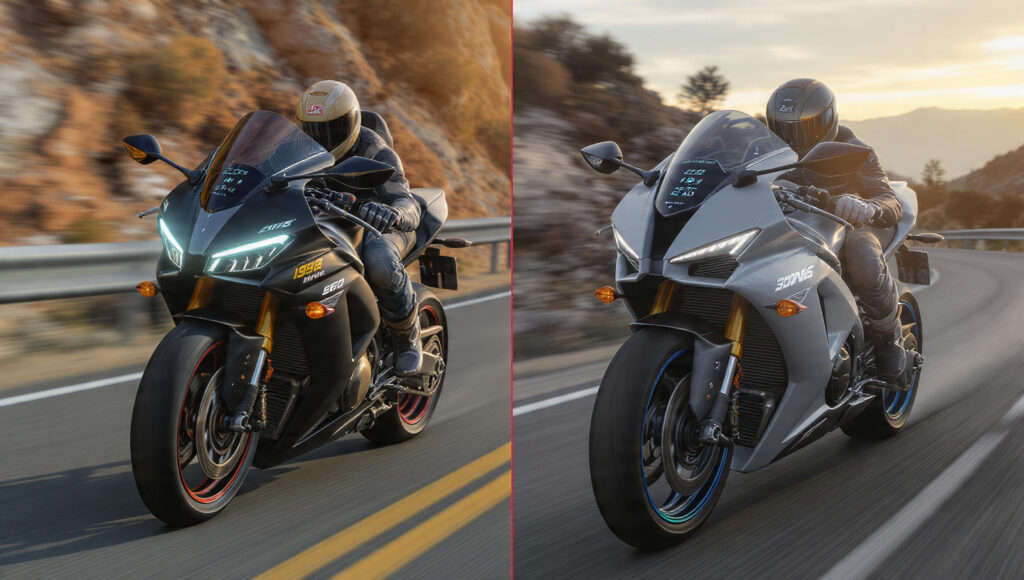
Kiran rides at night frequently. His new bike’s LED headlight illuminates the road far better than his old halogen. “I can see potholes and animals earlier. That’s crucial on rural highways,” he said.
LED adoption in India:
- Budget bikes: Becoming standard
- Mid-range: Universal
- Premium: Standard plus adaptive systems
Daytime Running Lights Make You Visible
DRLs automatically light up when the bike is running, making you visible to other vehicles even in daylight.
Studies show DRLs reduce daytime crashes by up to 27%. Other drivers notice bikes with DRLs significantly earlier.
Sneha commutes in Delhi traffic. Since buying a bike with DRLs, she’s noticed cars giving her more space. “They actually see me coming,” she said.
Cornering Lights Illuminate Through Turns
Some premium bikes now have cornering lights that activate based on lean angle, illuminating the inside of the turn.
Vikram’s Ducati Multistrada has this feature. “Night riding on mountain roads completely changed. I can see where I’m going, not just where I’m pointed,” he explained.
This technology is trickling down to mid-range bikes.
Connectivity Adds Safety Layers
Smartphone connectivity isn’t just about navigation and calls. It’s enabling new safety features.
Crash Detection and Emergency Alerts
Some modern bikes can detect crashes using accelerometers and gyroscopes. When detected, the system automatically:
- Calls emergency contacts
- Sends GPS location
- Alerts emergency services
- Logs crash data
Harman’s Kawasaki Versys has this feature. He crashed on a solo ride in a remote area. The bike automatically sent his location to his wife and emergency contacts. Help arrived 40 minutes later. Without this, he would’ve been lying there much longer.
Ride Tracking and Analysis
Connected systems track your rides, analyzing:
- Braking patterns
- Acceleration habits
- Cornering speeds
- High-risk behaviors
This data helps you identify and correct dangerous riding habits before they cause crashes.
Akash reviewed his ride data and realized he was braking too late and too hard at certain intersections. He adjusted his approach. Two weeks later, he avoided a crash at that same spot because he was already planning to brake earlier.
Theft Tracking and Geo-Fencing
Connected bikes can:
- Track location if stolen
- Alert you if moved without authorization
- Create geo-fences (get notified if bike leaves an area)
- Disable ignition remotely
Rashmi’s connected bike was stolen from her apartment parking. She tracked it to a location 15 km away and informed police. The bike was recovered within 6 hours.
Rider Gear Has Evolved Alongside Bikes
Modern bikes are safer, but modern gear makes the complete safety package.
Airbag Jackets and Vests Are Now Affordable
Motorcycle airbags used to cost ₹1+ lakh. Now they’re available for ₹15,000-40,000.
These airbags deploy in milliseconds during a crash, protecting:
- Chest and ribs
- Spine
- Neck
- Collarbones
Rajiv crashed at 70 km/h. His airbag vest deployed, absorbing massive impact to his chest and back. The orthopedic doctor said without it, he’d likely have broken ribs and spinal injuries.
CE-Rated Armor Is Standard
Good riding jackets now include CE-rated armor at:
- Shoulders
- Elbows
- Back
- Chest
This armor is designed to absorb and distribute impact forces, significantly reducing fracture risk.
Smart Helmets Add Features
Modern helmets include:
- Bluetooth communication
- Heads-up displays
- Rear-view cameras
- Emergency contact integration
Deepa’s smart helmet has a rear camera. She can see behind her without turning her head. “In Bangalore traffic, this has helped me avoid multiple close calls,” she said.
What All This Means for Riders
The combination of these technologies creates motorcycles that are:
- Faster without being more dangerous
- More forgiving of rider mistakes
- Better at preventing crashes
- More protective when crashes occur
Speed improvements (comparing similar class bikes 2010 vs 2025):
- 0-100 km/h: 15-25% faster
- Top speed: 10-20% higher
- Power-to-weight ratio: 20-30% better
Safety improvements:
- Crash survival rate: Significantly higher
- Injury severity: Noticeably reduced
- Preventable crashes: Substantially decreased
This isn’t theory. Talk to any rider who’s switched from a 2010-era bike to a modern equivalent. The difference is striking.
Common Questions Riders Ask
Do all these electronics make bikes less reliable? Modern electronics are actually very reliable. Most systems have redundancies. If a sensor fails, the bike defaults to a safe mode. Failure rates are quite low.
Can I turn off traction control and ABS if I want? Most bikes let you disable traction control. ABS typically can’t be fully disabled (legal requirement in many markets), though some bikes offer different ABS modes.
Are modern bikes more expensive to maintain? Initial purchase price is higher, but maintenance costs are often similar or lower. Electronic systems rarely fail, and service intervals are longer.
Do these features work on Indian roads? Yes. Companies test extensively in Indian conditions. ABS and traction control work on poor surfaces—in fact, that’s when they’re most valuable.
Are entry-level bikes getting these features? Yes, gradually. Features trickle down from premium bikes. What was exotic five years ago is becoming standard today.
The Road Ahead
Bike technology isn’t slowing down. Features coming in the next 3-5 years:
Adaptive cruise control: Maintains distance from vehicles ahead automatically
Blind spot monitoring: Warns you of vehicles in your blind spots
Automatic emergency braking: Applies brakes if imminent collision detected
Vehicle-to-vehicle communication: Bikes talking to each other and to cars, sharing hazard information
Some of these already exist on premium models. Soon, they’ll be everywhere.
Why This Matters
My uncle’s crash in 1998 left him with permanent wrist stiffness. He was lucky—many riders from that era weren’t.
Karthik’s crash in 2024 left him with fading bruises and a bike that needed fairings replaced. The safety systems worked exactly as designed.
That’s 26 years of progress.
Modern bikes are faster because:
- Engines are more powerful and efficient
- Electronics optimize power delivery
- Aerodynamics are better understood
- Materials are lighter and stronger
They’re safer because:
- Active safety systems prevent crashes
- Passive safety systems protect during crashes
- Frames and structures are crash-engineered
- Tires provide better grip and feedback
- Visibility is dramatically improved
You don’t have to choose between speed and safety anymore. Modern engineering delivers both.
Whether you’re buying your first bike or upgrading from an older model, these improvements mean your riding experience will be faster, more enjoyable, and significantly safer than it would have been even five years ago.
That’s not marketing hype. That’s engineering progress you can feel every time you twist the throttle.
And it keeps getting better.